Step by step
After a Car Accident in Cincinnati: What to Do Next
The first decisions after a collision are about safety and medical care. Paperwork, insurance, and crash reports matter too, but none of them should come ahead of an emergency symptom. This guide keeps those jobs in the right order and points Cincinnati-area drivers to the official sources that actually hold the records.
Order of operations
Safety and medical care first. Records and insurance after.
If symptoms are severe, rapidly worsening, or you have an emergency warning sign after a crash, call 911 or go to an emergency department. Some symptoms after a head or body jolt can appear hours or days later. Review the warning signs after a car accident if you are unsure what deserves emergency care.
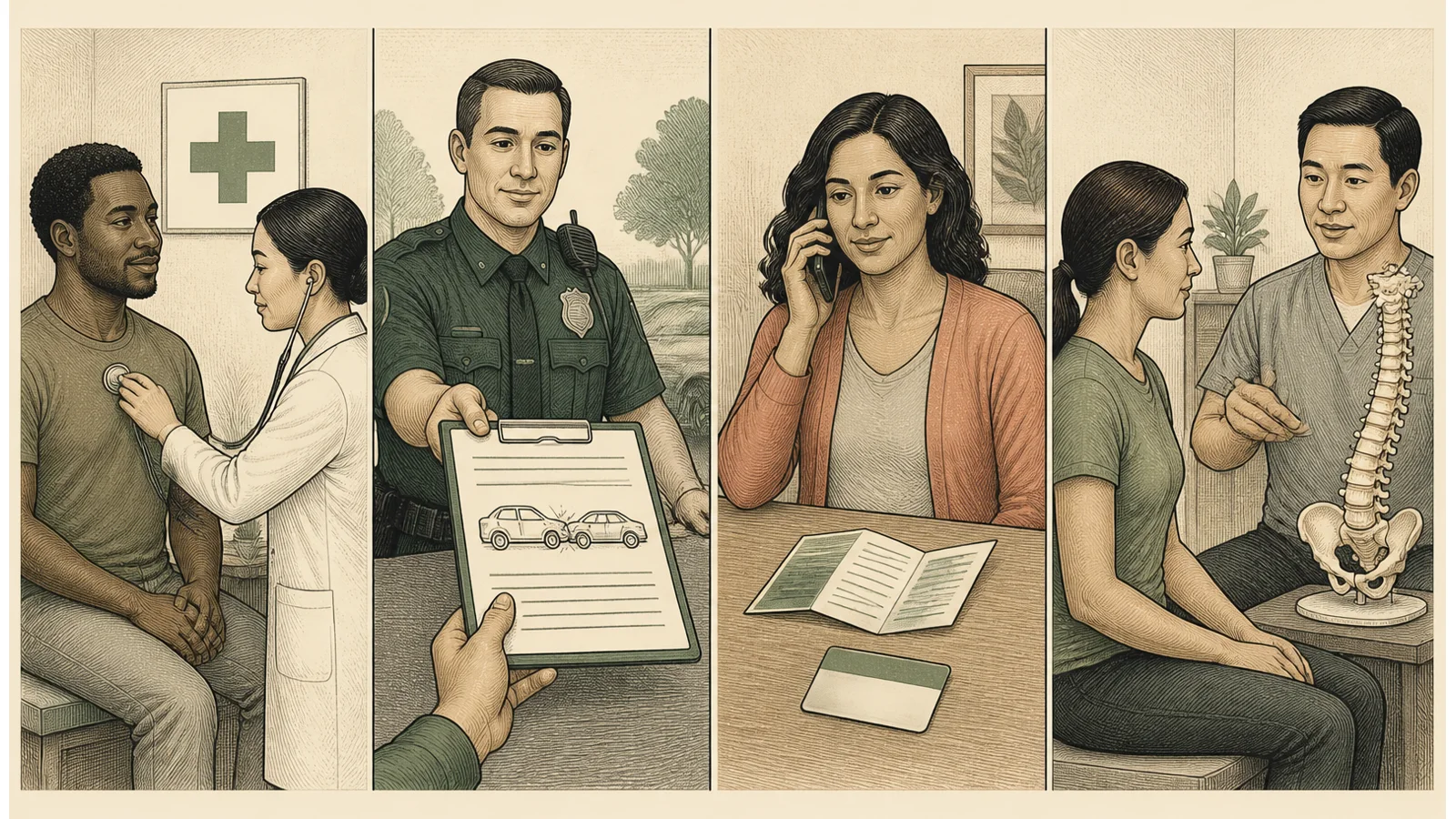
1. Handle Safety and Medical Needs First
If symptoms are severe, rapidly worsening, or include a post-crash danger sign, call 911 or go to an emergency department. If you were already evaluated, follow the discharge and follow-up instructions you were given. A new or worsening danger sign later still deserves care based on what is happening now.
Review the warning signs after a car accident.
2. Keep the Practical Information You Already Have
Once immediate safety is handled, keep the basic facts connected with the collision. You do not need to turn yourself into an investigator.
- The date, approximate time, and location of the collision
- The other driver's identifying and insurance information you were given
- Photos you already took of the vehicles or scene
- The responding agency, officer information, or report number you were given
- Medical discharge or follow-up instructions you received
These details help you communicate accurately with your insurer, healthcare providers, and the agency holding the report. This is practical organization, not legal advice about how to build a claim.
3. Get the Official Crash Report From the Investigating Agency
The police or law-enforcement agency that investigated the collision is the official record holder. Where the crash happened determines the agency, not where you live and not where you later receive care.
Ohio also provides a state crash-report search system. It can be useful, but the Ohio Department of Public Safety says a crash may take up to six weeks to appear there and that the copy available through the state system is not the official crash report. If you need the official record, request it from the investigating agency.
Search Ohio crash reports through the Ohio Department of Public Safety.
Cincinnati-Area Report Channels
Start with the department name on the paperwork the officer gave you. If you know where the crash happened but are unsure which agency responded, the local pages below explain the common west-side jurisdictions.
City of Cincinnati. If Cincinnati Police investigated the collision, use the Cincinnati Police Records Section information already cited in this project. Cincinnati Police Records Section.
Green Township. Green Township maintains its own police department and records process. Green Township Police records.
Colerain Township. If Colerain Township Police investigated the crash, use the existing official Colerain Township police records source. Colerain Township Police records.
For neighborhood-specific routing, see Green Township, White Oak, and Westwood.
Who Owns Which Question?
The fastest way to get stuck after a crash is to ask one organization a question that belongs to another. Use the source that actually controls the answer.
| Question | Best Source | What That Source Can Actually Answer |
|---|---|---|
| QuestionIs this symptom an emergency? | Best Source911, an emergency department, or an appropriate medical clinician | What That Source Can Actually AnswerWhether the current symptoms need urgent medical evaluation. |
| QuestionWho has the official crash report? | Best SourceThe law-enforcement agency that investigated the collision | What That Source Can Actually AnswerThe official agency record and its records-request process. |
| QuestionCan I search for a state copy? | Best SourceOhio Department of Public Safety crash-report search | What That Source Can Actually AnswerWhether a searchable state copy is available. Ohio notes that the state copy is not the official crash report. |
| QuestionWhat does my policy cover? | Best SourceThe insurer or health plan that issued the coverage | What That Source Can Actually AnswerPolicy-specific benefits, limits, deductibles, network rules, and documentation requirements. |
| QuestionWhat does a Spine & Motion evaluation cost? | Best SourceSpine & Motion | What That Source Can Actually AnswerThe clinic's current cash-pay price and what is required to schedule. |
| QuestionDoes my remaining neck or back complaint fit a musculoskeletal evaluation? | Best SourceAn appropriate healthcare professional | What That Source Can Actually AnswerWhether the current history and examination make conservative musculoskeletal care reasonable or point somewhere else. |
This division of responsibility is useful because it keeps medical care, public records, insurance, and treatment decisions from being blended into one vague “accident process.”
4. Notify Your Insurer and Ask Policy Questions Directly
Follow the reporting instructions in your own policy or claim materials. Coverage varies by policy, so use your insurer for policy-specific answers rather than relying on a clinic website.
Useful questions include whether your policy has medical payments coverage, whether a deductible or limit applies, what documentation is required, and whether another health or auto coverage may be involved.
See the car insurance and chiropractic care guide.
5. Pay Attention to Symptoms That Change
Feeling relatively well at the scene does not guarantee that nothing will become noticeable later. For concussion specifically, the CDC notes that some symptoms can appear hours or days after the injury. New or worsening symptoms should be judged by their current pattern and warning signs, not by whether they were present immediately.
Read the CDC concussion signs and danger signs.
For persistent neck or back soreness without an emergency warning sign, read about symptoms that appear after a crash.
6. If Neck or Back Symptoms Remain, Decide What Kind of Evaluation Fits
After urgent medical concerns have been addressed, ongoing neck or back soreness, stiffness, or limited movement can be reasonable to discuss with a musculoskeletal clinician. A chiropractic evaluation should not be used to replace emergency care or to diagnose a concussion.
See how car accident injury evaluation works at Spine & Motion.
Care at Spine & Motion is provided by Nicholas Heuker, DC.