Cincinnati Car Accident Recovery Guide
Cincinnati Car Accident Recovery Guide: What to Watch, What to Track, and What to Do Next
After a crash, it is easy for medical questions, soreness, police records, insurance questions, and everyday life to blur together. A better approach is to separate those questions and deal with each one in the right order.
If symptoms are severe, rapidly worsening, or you have an emergency warning sign after a crash, call 911 or go to an emergency department. Some symptoms after a head or body jolt can appear hours or days later. Review the warning signs after a car accident if you are unsure what deserves emergency care.
Start With What Is Happening Now
A car accident can create several problems at the same time, but they do not all belong to the same person or the same office.
The first question is medical safety. If you have severe or rapidly worsening symptoms, new weakness or numbness, repeated vomiting, a worsening headache, unusual confusion, trouble staying awake, seizure activity, or another serious change after a crash, use the site’s warning signs after a car accident guide and seek the level of medical care the symptoms require.
That comes before deciding whether chiropractic care makes sense.
The CDC notes that some concussion symptoms can appear hours or days after an injury. That does not mean every delayed headache or sore neck is a concussion. It means new or worsening symptoms deserve attention based on what they are, not simply how much time has passed.
CDC guidance on mild traumatic brain injury and concussion.
One Crash Can Create Four Different Questions
A useful way to think about the first few days is to separate four questions.
Medical question: Is there anything happening now that needs emergency, urgent, primary-care, or other medical evaluation?
Musculoskeletal question: If the urgent medical issues have been handled, what changed in the neck, back, shoulders, or normal movement, and does a musculoskeletal evaluation make sense?
Crash-record question: Which law-enforcement agency investigated the collision, and where does the official report come from?
Insurance question: What does your own policy cover, what does another insurer say, and what will a particular office charge?
Those questions overlap in real life, but they should not be blended together. A chiropractor does not determine fault. An insurance company does not diagnose a neck injury. A police report does not determine what treatment you need.
For the practical sequence, use what to do after a car accident in Cincinnati. For policy and payment questions, use car insurance and chiropractic care.

Track Function, Not Just a Pain Number
Pain matters, but function often tells the story more clearly.
Ask yourself what became harder after the crash.
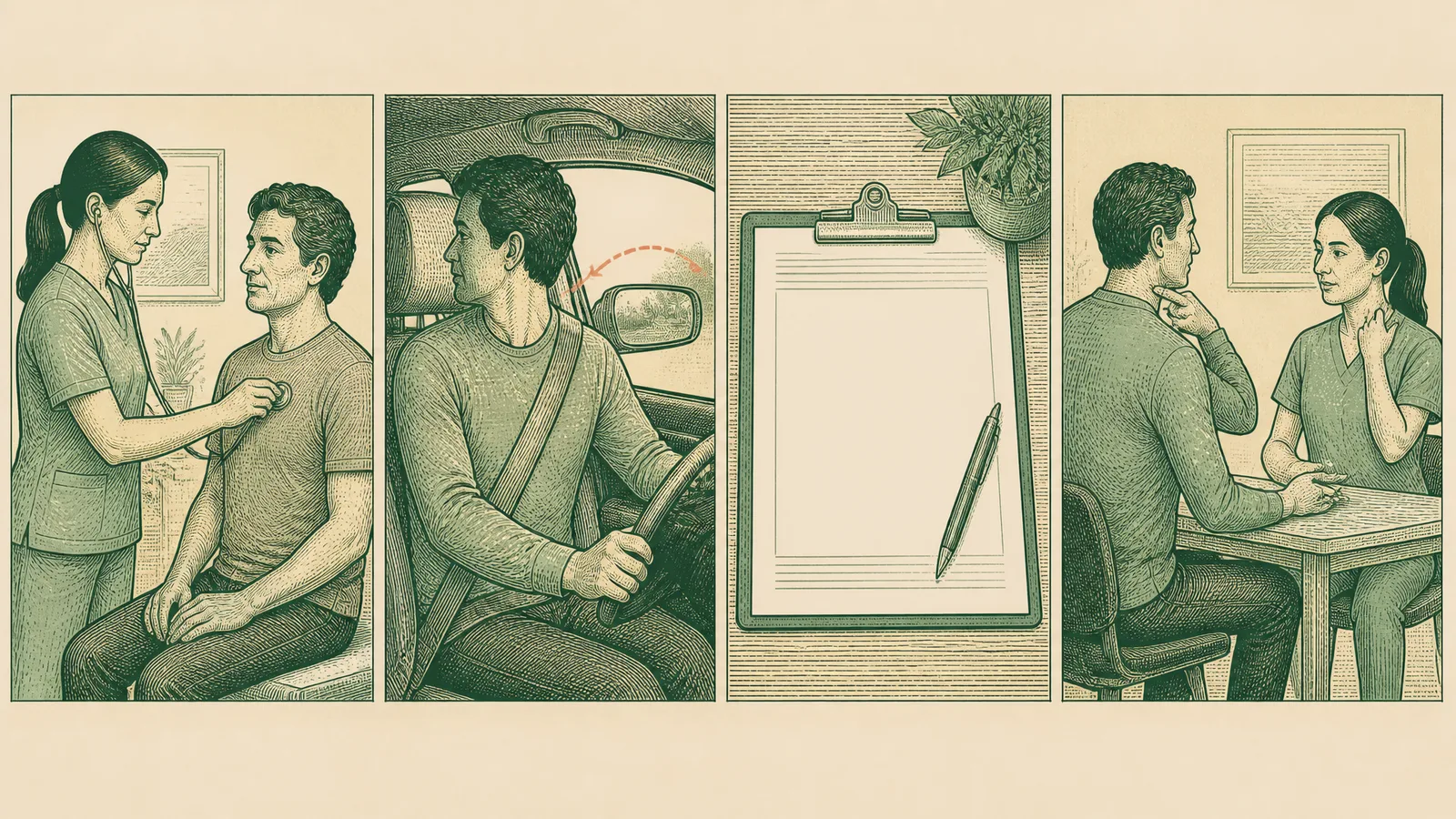
Can you turn far enough to check a blind spot? Is getting out of the car slower? Does sitting through work make the back tighten up? Are you waking because you cannot find a comfortable position? Is reaching overhead harder? Are you avoiding lifting a grocery bag that would normally be routine?
At Spine & Motion, we use this idea as a Function Snapshot. You do not have to arrive knowing whether a muscle, ligament, joint, disc, or nerve is responsible. Describing what changed gives the examination something concrete to sort out.
That is more useful than trying to diagnose yourself from a pain diagram.
Delayed Symptoms Are Useful History, Not a Diagnosis
Some people feel sore immediately. Others notice more stiffness or discomfort later that day or after sleeping.
The timing matters because it helps describe the history. It does not prove which tissue is injured, how severe an injury is, or whether a particular treatment is required.
The site’s delayed pain after a car accident guide explains this distinction in more detail.
There is also no responsible countdown that says a certain day proves an injury or that chiropractic care must begin within a magic number of hours. The decision should come from current symptoms, examination findings, medical instructions, and what is happening with function.
An Emergency Department Visit Answers Important Questions, But Not Every Future Question
If you were evaluated in an emergency department, follow the discharge instructions you were given.
Being discharged does not mean the visit was pointless. It means the emergency team made decisions based on what they found at that time. If new warning signs appear later, respond to those symptoms rather than assuming the earlier visit cleared every future possibility.
If urgent concerns have been addressed but neck or back movement, sleeping, sitting, lifting, or other normal activity is still limited, that may become a separate musculoskeletal follow-up question.
The Official Crash Report Follows the Investigating Agency
A common Cincinnati-area mistake is assuming the report belongs to the city where you live or the office you visit.
The more useful question is: Which agency investigated the crash?
The Ohio crash-search system can help locate records, but the investigating law-enforcement agency is the official record holder. Depending on where the collision occurred, that may be Cincinnati Police, Green Township Police, Colerain Township, or another agency.
Ohio’s crash-report search system.
Our after a car accident page explains the records process without turning medical care into claim strategy.
Where Chiropractic Care May Fit
Chiropractic care is not the answer to every problem after a crash.
It may be relevant when the emergency questions have been handled and a person is dealing with musculoskeletal complaints such as neck pain, back pain, stiffness, restricted movement, or activity limitations that are appropriate for a chiropractic evaluation.
The goal of the first visit is not to force every patient into the same treatment plan. It is to understand what happened, what changed, what the examination finds, whether chiropractic care is appropriate, and whether another type of care should come first.
Read what chiropractic care can and cannot do or what to expect as a new patient before scheduling if you want more detail.
Recovery Should Become Easier to Describe Over Time
There is no universal recovery calendar.
A better question is whether important functions are changing in the right direction. Can you turn farther? Sit longer? Sleep more comfortably? Walk normally? Work with fewer limitations? Lift ordinary objects more comfortably?
If the answer is yes, that is meaningful progress. If function is not improving, symptoms are changing in a concerning way, or the plan no longer makes sense, reassessment matters.
That is the point of follow-up: not endless visits, but a reasoned decision about whether the current approach is helping.
Build a Simple Post-Crash Record for Yourself
You do not need to build a legal file or diagnose your own injury. It can still help to keep a simple factual record of what happened and what changed.
Write down the date of the collision, where it happened, which agency responded, whether you were the driver or passenger, and whether you were evaluated medically. Keep the discharge instructions or other records you were given.
Then add the part that matters clinically: what normal activities became harder.
Maybe you could turn your head normally before the crash and now checking a blind spot is uncomfortable. Maybe sitting at work was never a problem and now the lower back tightens after 30 minutes. Maybe you normally sleep through the night and now you wake when you roll over.
Those observations are useful because they describe change without trying to assign a diagnosis.
Do Not Let Vehicle Appearance Become the Medical Conclusion
People naturally look at the car and make assumptions.
A small dent can make someone wonder whether they are “allowed” to hurt. A badly damaged car can make someone assume that a serious injury must have occurred.
Neither conclusion is reliable.
Vehicle damage is part of the crash history. It is not a medical examination.
The body’s response depends on many factors, including occupant position, restraint use, direction of force, prior health, and what symptoms appeared afterward.
The clinical question should be based on the person, not on how dramatic the bumper looks in a photograph.
Use the Right Source for the Right Question
One of the easiest ways to create confusion after a crash is to ask the wrong source to answer a question.
A police agency can tell you about the official crash report. It cannot diagnose your neck.
An insurance company can explain policy coverage. It cannot determine whether a musculoskeletal treatment is clinically appropriate.
A chiropractic office can explain its fees and evaluate appropriate musculoskeletal complaints. It cannot determine legal fault or promise what an insurer will pay.
An emergency department can evaluate urgent medical concerns. It is not designed to provide every type of follow-up care a person might need over the next several weeks.
Separating those roles keeps the process cleaner.
A Function Snapshot Should Be Specific
“Everything hurts” is real, but it is hard to measure.
A more useful Function Snapshot names a few activities.
For example:
- turning the head to the left while driving
- sitting at a desk for 45 minutes
- standing from a low chair
- reaching to a top shelf
- carrying a grocery bag
- sleeping on the right side
Then describe what happens.
Is the activity painful immediately? Does stiffness build over time? Is the range of motion limited? Do you guard the movement because you expect it to hurt?
Those details give the evaluation something concrete to work with and give later reassessment something concrete to compare.
When the Next Step Is Not Chiropractic Care
A musculoskeletal clinic should be able to say when a problem does not belong there.
If the history or current symptoms suggest that emergency, medical, neurological, or another evaluation should come first, that should change the plan.
Likewise, if a person is improving well without office-based care, the existence of a collision does not automatically create a need for treatment.
The purpose of the evaluation is to decide whether chiropractic care fits the remaining problem, not to prove that every crash requires chiropractic care.
Cincinnati-Area Records Can Be More Local Than People Expect
A crash in the Cincinnati area may involve Cincinnati Police, Green Township Police, Colerain Township, the Ohio State Highway Patrol, or another agency depending on the exact location and who investigated.
That is why “Where do I get my report?” is best answered by identifying the investigating agency first.
The local pages on this site explain some of those jurisdiction differences for Green Township, White Oak, and Westwood.
That local detail matters because it turns a generic instruction into a practical next step.
What a Good Next Decision Looks Like
After the urgent medical question is handled, a good next decision should feel narrower and clearer.
You should know what changed, what function matters, which questions belong to the clinic, and which questions belong somewhere else.
If the remaining problem is musculoskeletal and is limiting ordinary movement, an evaluation can help decide whether chiropractic care belongs in the plan.
If it does not, the answer should still become clearer.
Clarity is a useful outcome too.
That is the goal of the recovery framework: not to make every crash complicated, but to keep several different questions from becoming one confusing problem.
The Practical Bottom Line
After a Cincinnati car accident, do not make one person or one website answer every question.
Handle medical safety first. Use the investigating agency for the official crash record. Use the insurer for policy questions. Use a qualified clinician to evaluate symptoms and function. And if the remaining problem is musculoskeletal, Spine & Motion can help determine whether chiropractic care belongs in the plan.
If you want to discuss a visit, contact Spine & Motion or call the office.
Published August 21, 2026
Care at Spine & Motion is provided by Nicholas Heuker, DC.