Work and recovery
Going Back to Work After a Car Accident Injury
There is no responsible website rule that says everyone should return to work after the same number of days. A desk job, a warehouse shift, a delivery route, and a job that involves climbing or machinery place very different demands on someone who is still recovering from a crash.
If symptoms are severe, rapidly worsening, or you have an emergency warning sign after a crash, call 911 or go to an emergency department. Some symptoms after a head or body jolt can appear hours or days later. Review the warning signs after a car accident if you are unsure what deserves emergency care.
Start With Any Medical Restrictions You Were Given
If a clinician gave you written restrictions, a return-to-work date, medication precautions, or follow-up instructions, use those rather than a blog article. If the restrictions no longer match what is happening, ask the clinician who issued them or another appropriate medical professional to reassess you.
The Job Matters as Much as the Pain Number
The relevant question is not simply whether the pain is a three or a seven. It is what the job requires and whether the symptoms interfere with doing those tasks safely.
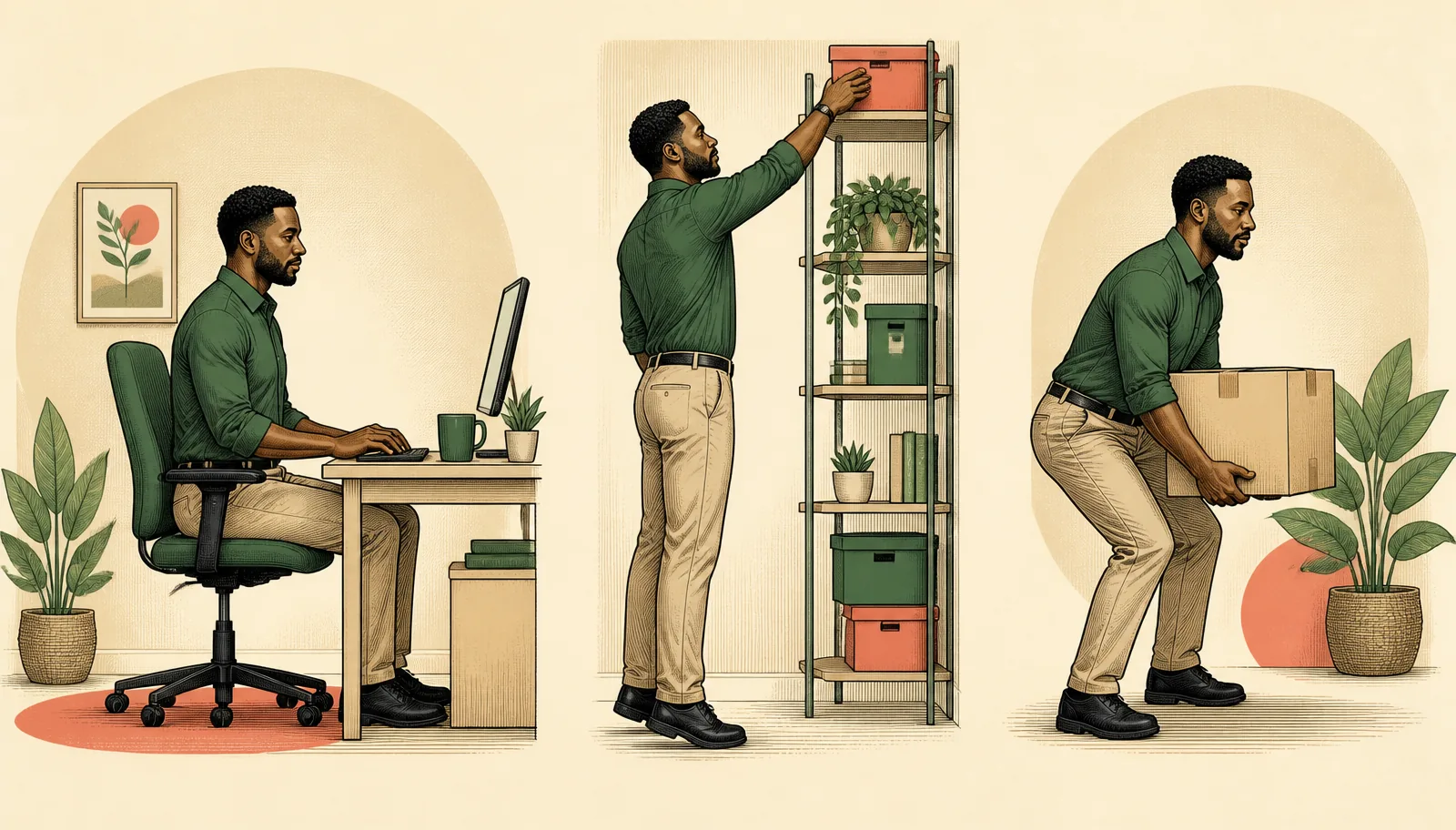
A person at a computer may struggle with sustained sitting or turning the head between screens. Someone who lifts may have trouble with load, reach, or repeated bending. A driver may have an entirely different safety problem if neck motion, dizziness, medication effects, or concentration interfere with operating a vehicle.
NIOSH guidance on promoting worker recovery emphasizes matching work demands with a worker’s current capabilities and restrictions.
Describe the Task That Is Hard
At follow-up, specific work tasks are more useful than saying "work hurts."
- How long you can sit, stand, or walk comfortably
- Whether turning your head is limited
- Whether lifting, reaching, pushing, or pulling changes the symptoms
- Whether medication makes you drowsy or slows your thinking
- Whether symptoms are improving, worsening, or remaining about the same through the workday
Those observations do not clear you for work. They help a clinician understand what function needs to be assessed.
A First Shift Back Is Information, Not a Test of Character
Do not treat a difficult shift as proof that you failed recovery, and do not treat getting through one shift as medical proof that every task is safe. Recovery and work tolerance can change with duration, repetition, sleep, medication, and the demands of the job.
If a return causes severe worsening, new neurological symptoms, dizziness, confusion, or another concerning change, stop using a work article as your guide and get medical advice.
When Follow-Up May Be Useful
If urgent medical concerns have been addressed but neck or back symptoms are still interfering with normal work activity, a musculoskeletal evaluation may help determine what appears appropriate for conservative care and what requires another kind of follow-up.
See how post-crash evaluation works.
Returning to Work Is a Function Question
The calendar date does not know what your job requires.
A person who works at a computer may struggle with prolonged sitting or turning the head between monitors. A warehouse worker may need to lift, carry, push, pull, climb, or reach overhead. A driver may need comfortable neck rotation, attention, reaction time, and enough sitting tolerance to stay safe.
That is why “Can I go back to work?” is often too broad.
A better question is, “Which parts of my job can I do safely and normally right now, and which parts are still limited?”
Match the Restriction to the Actual Demand
If a clinician gives work restrictions, those restrictions are most useful when they connect to the real job.
“Light duty” can mean very different things in different workplaces.
For one person, the issue may be avoiding heavy lifting. For another, the limiting factor may be sitting longer than 30 minutes at a time. Someone else may have trouble reaching overhead or repeatedly turning the head.
NIOSH guidance on worker recovery emphasizes the relationship between work demands and a worker’s current capabilities and restrictions.
That idea matters because vague restrictions are harder for both the worker and employer to use.
Use a Work-Specific Function Snapshot
Before returning, identify the tasks that actually matter.
Can you sit through the required period? Stand long enough? Lift the usual objects? Reach where the job requires? Turn the head enough to drive or operate equipment safely?
Then pay attention to what happens during and after the task.
If a short period of work is manageable but a full shift creates a major increase in symptoms, that is useful information for reassessment.
Do Not Turn Determination Into a Toughness Test
Pushing through symptoms to prove you can work is not the same thing as a safe return.
Neither is staying out of work automatically better.
The goal is to make the return fit the person’s current function and the actual job.
If urgent medical concerns have been handled but neck, back, or shoulder-area limitations are still interfering with work, a musculoskeletal evaluation may help clarify what movement is restricted and whether chiropractic care fits the remaining problem.
For a broader view of post-crash neck, back, and shoulder complaints, use the function-based pain guide. It connects symptom location with the real activities that changed instead of relying on a pain number alone.
Returning in stages can also provide useful information when the employer and medical guidance allow it. A shorter shift, modified task, or temporary change in lifting demand may reveal whether the main limitation is sitting tolerance, repeated turning, reaching, or load. The point is not to create a universal return-to-work formula. It is to connect the work demand to the actual function that still needs to improve.
Keep the restriction specific enough that the employer can understand it and the clinician can reassess it. A vague instruction that never changes is harder to use than a restriction tied to a real task and a clear follow-up point.
Published September 20, 2026
Care at Spine & Motion is provided by Nicholas Heuker, DC.