Post-Crash Pain and Function
Neck, Back, and Shoulder Pain After a Car Accident: A Function-Based Guide
After a collision, people usually do not think in anatomy. They think, “It hurts here,” “I cannot turn like I normally do,” or “This got worse when I tried to work.” Those details are useful, even when they do not identify the diagnosis by themselves.
If symptoms are severe, rapidly worsening, or you have an emergency warning sign after a crash, call 911 or go to an emergency department. Some symptoms after a head or body jolt can appear hours or days later. Review the warning signs after a car accident if you are unsure what deserves emergency care.
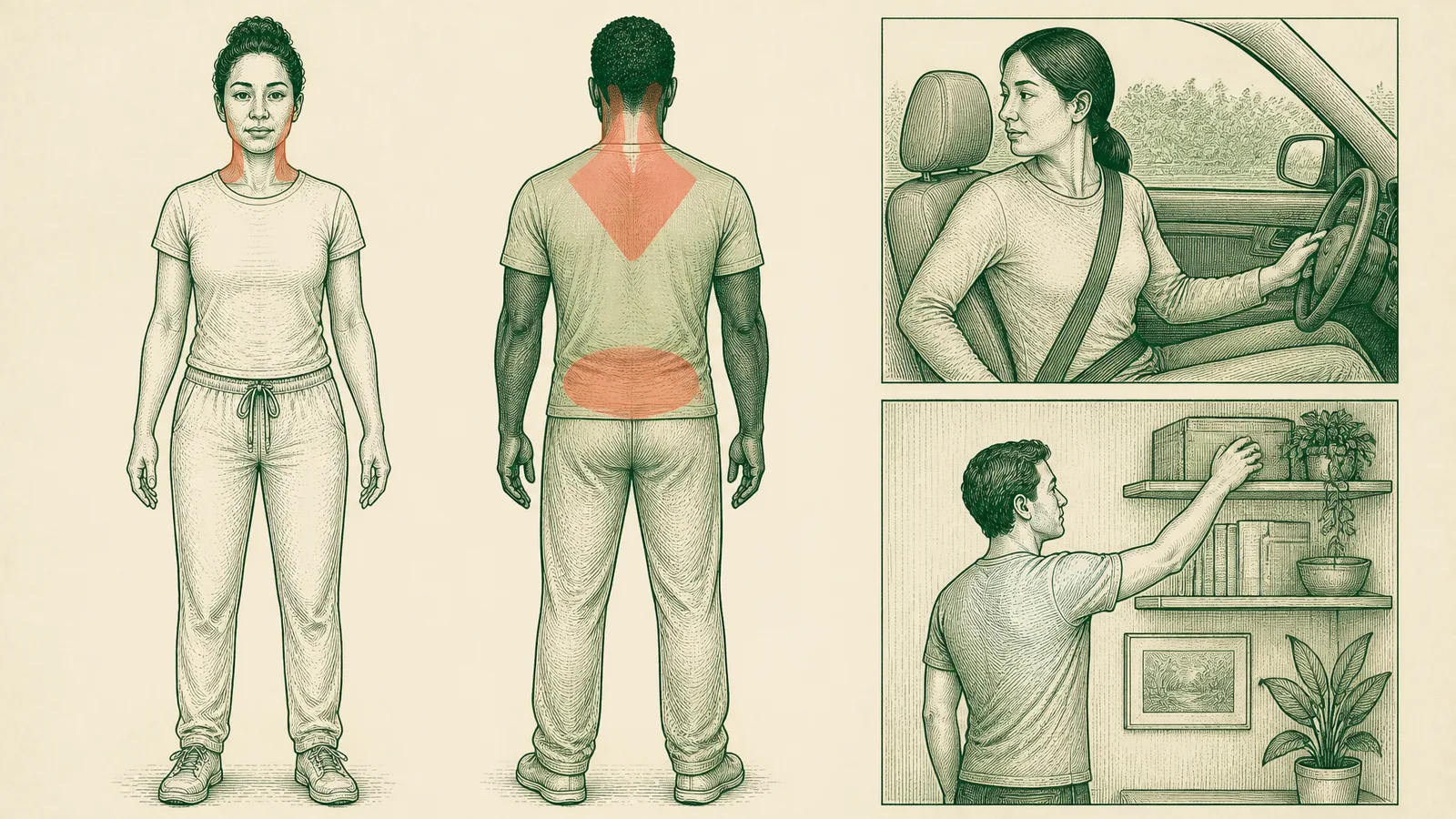
Pain Location Helps Describe the Problem
A pain map can be useful because it gives you a starting point.
After a crash, people may report discomfort at the base of the skull, along one or both sides of the neck, across the shoulders, between the shoulder blades, through the lower back, or sometimes into the buttock or leg.
That location matters. It just does not answer every question.
Pain in the shoulder does not automatically mean the shoulder joint is the source. Pain between the shoulder blades does not automatically mean the problem is in the thoracic spine. A headache after a crash should not automatically be labeled a neck headache.
The examination has to connect the history, the symptom pattern, movement, function, and any warning signs.
Neck Pain After a Crash
Whiplash is a common term for a soft-tissue neck sprain or strain associated with sudden force. MedlinePlus describes whiplash as a neck sprain or strain, but the word itself does not tell you the exact structure involved, the severity, whether imaging is needed, or how many visits someone will need.
MedlinePlus information on neck injuries and whiplash.
The whiplash guide explains the motion and the limitations of the label. The broader neck pain page separates accident-related neck pain from gradual desk/posture complaints.
Useful functional questions include:
- Is turning your head to check traffic harder?
- Is looking up or down more limited?
- Does sitting through work increase the discomfort?
- Are you waking because the neck will not settle into a comfortable position?
Those answers give more context than “my pain is a seven.”
Shoulder and Upper-Back Pain Can Be Part of the Picture
During a collision, the body may interact with the seat, head restraint, shoulder belt, steering wheel, door, or other parts of the vehicle.
That can leave someone noticing soreness across a shoulder, the upper trapezius area, or between the shoulder blades.
But the location alone still does not diagnose the injury. Shoulder-area discomfort can have more than one source, including structures in the shoulder itself and structures in the neck or upper back.
A useful history includes what the arm can and cannot do now. Reaching overhead, putting on a jacket, carrying a bag, sleeping on one side, or reaching across the body may provide useful functional clues.
Low-Back Pain After a Collision
Back pain can remain centered in the lower back or sometimes extend toward the buttock or leg.
That symptom direction is worth reporting. It does not automatically identify a disc problem, pinched nerve, or sciatica.
The back pain guide explains how the office separates significant trauma from routine non-traumatic back pain and why the history matters before applying ordinary lifting or self-care advice.
NCCIH notes that spinal manipulation is one of several nondrug approaches that may provide small improvements in pain and function for some people with low-back pain. The evidence is about groups of patients. It cannot decide whether manipulation is appropriate for one person after a fresh collision.
NCCIH’s evidence summary on spinal manipulation.
Headaches Need Their Own Question
A headache after a crash can have more than one possible source.
Muscles and joints near the base of the skull can contribute to some headache patterns, but concussion and other medical problems can also cause headaches after trauma.
That is why the site’s headaches after a crash page puts warning signs before the musculoskeletal discussion.
A chiropractic examination can evaluate neck-related musculoskeletal findings. Chiropractic care is not concussion treatment.

Function Often Shows the Real-Life Impact
Ask what the problem is stopping you from doing normally.
A neck complaint may matter because you cannot check a blind spot. A back complaint may matter because standing from a chair is slow and guarded. Shoulder-area pain may matter because reaching for a shelf is difficult. A headache may matter because concentration, light, or normal activity changes the experience.
That is the difference between identifying a painful area and understanding how the problem is affecting your life.
When Medical Evaluation Comes First
Pain after a crash should not be treated as a routine mechanical complaint when serious warning signs are present.
New or worsening neurological symptoms, severe headache patterns, repeated vomiting, unusual confusion, significant weakness or numbness, loss of consciousness or difficulty waking, seizure activity, or other serious changes belong with appropriate medical care.
Use the full warning-sign guide rather than relying on a short list in a blog article.
What a Musculoskeletal Evaluation Can Add
Once urgent medical issues have been handled, an evaluation can help connect the crash history with movement, tenderness, functional limits, and other examination findings.
It can also answer a question that a pain diagram cannot: Does this look like a problem that belongs in this office, or is another type of evaluation more appropriate?
That is the decision Spine & Motion is trying to make, not simply whether the patient can point to a sore spot.
For a broader overview, start with car accident injury evaluation and chiropractic care. If you are deciding whether to schedule, see what to expect at the first visit.
Pain That Spreads Needs Description, Not a Label
People often use words such as “radiating,” “shooting,” “burning,” or “traveling” when discomfort moves away from the place where it started.
Those words matter.
They can help describe whether a neck complaint stays local, reaches into a shoulder or arm, or whether lower-back symptoms extend toward the buttock or leg.
But the direction of symptoms does not automatically establish a pinched nerve, disc injury, or sciatica.
A clinician still has to connect the symptom pattern with the history, examination, neurological findings, movement, and function.
The Shoulder Can Be a Shoulder Problem or Part of a Neck Pattern
Shoulder pain after a crash is a good example of why location and diagnosis are not the same thing.
A person may feel soreness at the top of the shoulder from belt contact, discomfort around the shoulder blade, pain when lifting the arm, or symptoms that seem to begin in the neck and move toward the shoulder.
Those patterns can involve different structures.
A useful history asks what the shoulder can do now.
Can you reach overhead? Put on a coat? Fasten a seat belt? Sleep on that side? Carry a bag? Reach behind you?
Those function questions help separate “it hurts near my shoulder” from a more complete picture.
Neck Motion Matters Because Real Life Requires Rotation
The neck is not only responsible for looking straight ahead.
Driving requires rotation. Work may require looking between monitors. Parents look down, lift, and turn repeatedly. Sleeping requires the neck to tolerate one position for a long period.
That is why accident-related neck pain can become frustrating even when the person is not in severe pain every minute.
A small loss of motion can create a large real-world inconvenience.
This is also why the existing forward-head-posture illustration on the neck-pain page belongs in a different part of the conversation. Gradual posture-related strain and fresh trauma can both produce neck complaints, but the mechanism and clinical history are not interchangeable.
Pain Diagrams Are Recognition Tools
A body illustration can be extremely useful for a person who is trying to decide whether a page is relevant.
Seeing neck, shoulder-blade, or lower-back areas highlighted can create an immediate reaction: “That is where I feel it.”
That is valuable.
The limitation is equally important.
The image is a recognition tool, not a diagnostic map.
Two people can point to the same location and have different reasons for the symptom. One person can also have more than one contributing source.
That is why the best use of a pain-location illustration is to start the conversation, not finish it.
Compare Against Your Own Baseline
Before the collision, could you turn your head normally? Reach overhead? Sit for two hours? Sleep on either side? Walk without guarding?
That baseline matters.
A person with pre-existing arthritis or occasional back stiffness can still describe a meaningful new change after a crash.
The existence of an old condition does not automatically explain every new symptom.
The crash also does not prove that every old condition became worse.
The examination has to separate what was already present from what changed.
That comparison is especially useful when an old complaint existed before the collision but the location, intensity, movement limit, or daily impact now feels different.
A Useful Evaluation Should Reduce Uncertainty
After the history and examination, the patient should have a clearer understanding of the next question.
Does the pattern appear musculoskeletal and appropriate for the office?
Are there findings or symptoms that suggest another evaluation should come first?
What function will be watched if care begins?
What would cause the plan to change?
That is more useful than simply naming the painful area.
The larger Cincinnati car accident recovery guide connects these symptom questions to medical safety, official records, insurance, and follow-up care so the patient can keep each decision in the right lane.
That comparison also helps the patient describe whether the limitation is changing over time.
Published August 21, 2026
Care at Spine & Motion is provided by Nicholas Heuker, DC.