After the ER visit
The Emergency Department Evaluated You. What if You Are Still Sore After the Crash?
An emergency department visit after a collision is important, especially when there is concern about a head injury, fracture, internal injury, severe pain, or another urgent problem. Being discharged does not mean you imagined the soreness that remains, and it does not mean every symptom that appears later should be ignored.
If symptoms are severe, rapidly worsening, or you have an emergency warning sign after a crash, call 911 or go to an emergency department. Some symptoms after a head or body jolt can appear hours or days later. Review the warning signs after a car accident if you are unsure what deserves emergency care.
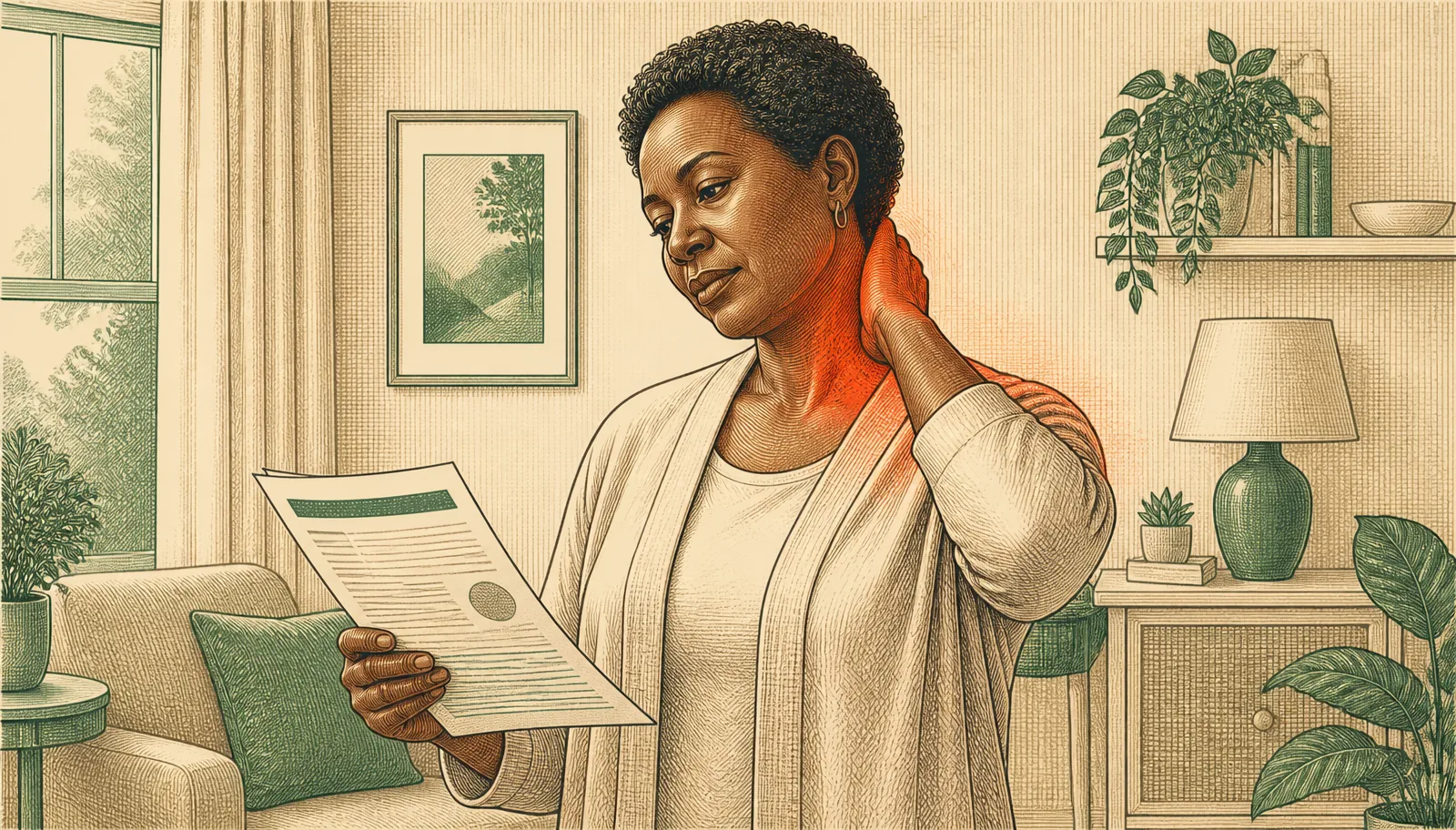
What an Emergency Department Visit Does and Does Not Mean
Emergency clinicians evaluate the problems suggested by your history, examination, vital signs, and any testing they determine is needed. If you are discharged, follow the instructions and follow-up recommendations you were given.
A discharge is not a lifetime guarantee that no symptom can change. It also is not proof that persistent neck or back soreness needs chiropractic care. Those are separate questions.
New or Worsening Symptoms Still Matter
The CDC notes that some mild traumatic brain injury or concussion symptoms may appear hours or days after a head or body jolt. A new or worsening danger sign deserves medical attention based on what is happening now, even if you were evaluated earlier.
Read the CDC concussion signs and danger signs.
Use the post-crash warning-sign page if you are unsure which changes call for emergency care.
What if the Remaining Problem Is Mainly Neck or Back Soreness?
Once urgent medical concerns have been addressed, ongoing stiffness, soreness, or limited comfortable movement can be reasonable to discuss with a musculoskeletal clinician. That follow-up is not a second emergency evaluation and should not be presented as one.
A chiropractic evaluation can ask what changed, how movement is limited, what reproduces the complaint, and whether the problem appears appropriate for conservative care. If the findings point somewhere else, the next step should change.
See how car accident injury evaluation works at Spine & Motion.
What to Bring Forward From the ER Visit
- The discharge and follow-up instructions you were given
- Any test or imaging reports you already have access to
- A current medication list
- What symptoms have improved, stayed the same, or changed since the visit
Do not stop a prescribed medication, ignore a restriction, or replace medical follow-up with a blog article because another symptom feels more musculoskeletal now.
The Useful Question Is What Has Changed
A better follow-up question than "Was I cleared?" is: what is happening now compared with when I was evaluated?
If the answer includes a new danger sign, use medical care. If the answer is persistent neck or back soreness without an emergency feature, ask whether a musculoskeletal evaluation makes sense.
What an ER Visit Usually Answers
An emergency department has a different job than a musculoskeletal office. Its first concern is whether there is something dangerous or time-sensitive happening that needs immediate medical attention. That can include serious head injury, fracture, internal injury, major neurological change, or another condition that should not wait.
That is why an ER visit can be completely appropriate even when the person is still sore afterward.
The useful question is not, “Did the ER fix every problem?” It is, “What questions did the ER evaluate at that time, and what questions remain now?”
Being Cleared for an Emergency Is Not the Same as Being Back to Normal
A person can leave the emergency department without being admitted and still notice that normal movement is different.
Maybe turning the head is harder. Maybe sitting through a workday causes the back to tighten up. Maybe getting out of the car takes longer. Maybe sleep is uncomfortable because the neck does not settle easily.
Those details matter because they describe function.
At Spine & Motion, a useful way to describe this is the Function Snapshot: what could you do normally before the collision, what is harder now, and is that activity improving, staying the same, or getting worse?
That does not diagnose the injured structure. It gives the next clinician something concrete to evaluate.
What Imaging Can and Cannot Settle
People sometimes assume that a normal X-ray or another reassuring test means every possible source of soreness has been ruled out. That is too broad.
Different tests answer different questions. An imaging result should be interpreted in the context of the symptoms, examination, trauma history, and the reason the test was ordered.
The opposite mistake is also common. Ongoing soreness does not automatically mean advanced imaging is necessary.
Whether another test is appropriate is a clinical decision. A website cannot responsibly make that decision from the fact that pain continued after an ER visit.
A Better Follow-Up Question
Once urgent medical concerns have been handled, ask a narrower question:
Is the remaining problem mainly musculoskeletal, and is it affecting movement or ordinary function enough to justify an evaluation?
That is where chiropractic care may fit for some people. It is not a replacement for emergency medicine. It is a different type of follow-up question.
A musculoskeletal examination can look at movement, tenderness, range of motion, symptom behavior, and the daily activities that changed after the crash. It can also identify reasons another type of care should come first.
For a broader framework, use the Cincinnati car accident recovery guide. It separates medical safety, functional change, crash records, insurance questions, and musculoskeletal follow-up so one office is not expected to answer everything.
Do Not Use the Calendar as the Diagnosis
The fact that you are still sore the next morning, three days later, or a week later is part of the history. It is not a diagnosis by itself.
Some symptoms are immediate. Others become more noticeable later. The important part is what the symptoms are, whether there are warning signs, what function changed, and how the pattern is evolving.
That is more useful than trying to fit yourself into a universal timeline.
What to Bring to a Follow-Up Visit
If you decide to schedule a musculoskeletal evaluation, bring the information that helps explain the story:
- what happened in the collision
- whether you were the driver or passenger
- where you were seated
- what medical evaluation you already had
- what instructions you were given
- what symptoms changed afterward
- what normal activities are harder now
- what medications or health conditions the clinician should know about
You do not need to arrive with a self-diagnosis.
The goal is to make the next decision clearer.
Keep the Discharge Instructions in the Conversation
If the emergency department gave you activity limits, medication directions, follow-up instructions, or reasons to return for care, bring that information forward instead of treating the next visit as a fresh start. A musculoskeletal clinician should know what the earlier medical team advised. That helps keep follow-up care connected rather than creating two separate versions of the same post-crash story.
Also note what changed after the ER visit. If neck rotation, sitting tolerance, sleep, walking, or another ordinary activity became harder later, that change belongs in the follow-up history. It does not cancel the earlier evaluation. It gives the next clinician a clearer picture of what developed after that point.
Published August 25, 2026
Care at Spine & Motion is provided by Nicholas Heuker, DC.