Role and Limits of Chiropractic Care
Chiropractic Care After a Car Accident: What It Can Help Assess and What It Cannot
After a crash, “Should I see a chiropractor?” is not the first question for every person. The better sequence is to handle urgent medical concerns first, then decide whether the remaining neck, back, or movement problem belongs in a musculoskeletal office.
If symptoms are severe, rapidly worsening, or you have an emergency warning sign after a crash, call 911 or go to an emergency department. Some symptoms after a head or body jolt can appear hours or days later. Review the warning signs after a car accident if you are unsure what deserves emergency care.
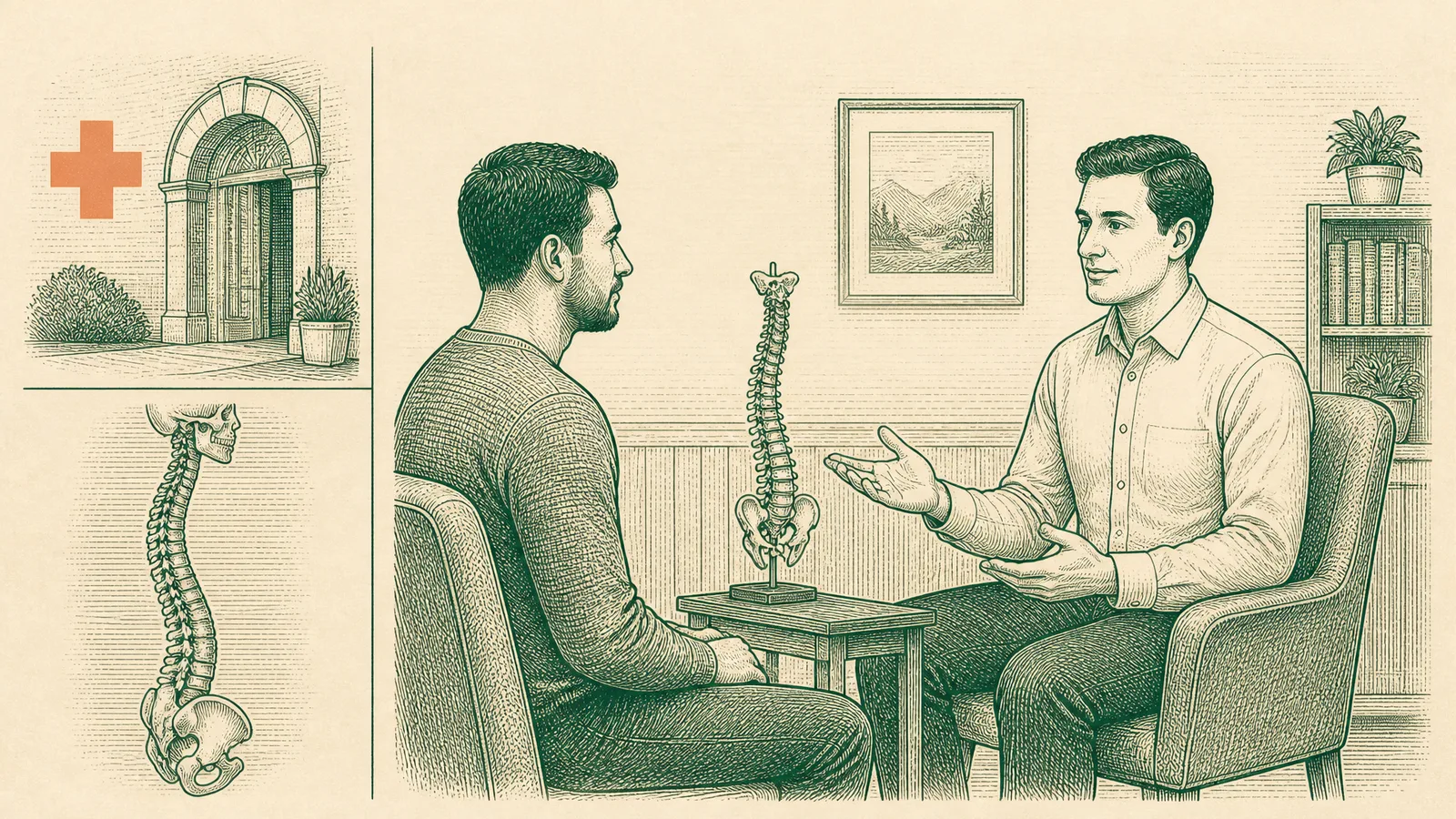
Chiropractic Care Is One Part of the Decision
A collision can create medical, neurological, musculoskeletal, insurance, and records questions at the same time.
Chiropractic care belongs in the musculoskeletal part of that picture.
It does not replace emergency evaluation when serious warning signs are present. It does not determine fault. It does not interpret an insurance policy. It does not make a concussion diagnosis disappear because the neck is also sore.
That separation is important because it keeps the patient from asking one office to answer questions it does not control.
What a Chiropractic Evaluation Can Look At
A chiropractic evaluation can examine things such as:
- where neck or back symptoms are being felt
- which movements reproduce or change the complaint
- range of motion
- tenderness and musculoskeletal findings
- whether ordinary activities are limited
- whether the history and examination fit the type of care offered in the office
It can also identify reasons the clinician should stop and recommend a different type of evaluation.
The first goal should be understanding the problem, not automatically delivering the same treatment to every patient.
What the Research Can Tell You
NCCIH describes spinal manipulation as one of several nondrug approaches used for low-back pain and some neck-pain conditions. The evidence suggests small or modest improvements in pain or function for some groups of patients, while the strength and consistency of evidence varies by condition.
NCCIH’s current overview of spinal manipulation.
That evidence is useful, but it has limits.
A research result about an average group does not tell you whether a fresh post-collision complaint is safe to manipulate. It does not tell you which treatment should be used on the first visit. It does not tell you how many visits one person needs.
Those are individual clinical decisions.
Safety Has to Be Part of the Conversation
NCCIH notes that temporary soreness, stiffness, or headache can occur after spinal manipulation. Serious complications have been reported but are rare, and certain underlying health problems may increase risk.
That is one reason the medical history matters.
After a collision, the clinician also has to consider the trauma itself, current symptoms, medications, previous conditions, and any warning signs before deciding whether manipulation or another approach is appropriate.
A responsible discussion of chiropractic care includes both possible benefits and limitations.
Chiropractic Care Does Not Treat a Concussion
This distinction matters enough to say plainly.
A person can have neck pain after a crash and also have a concussion. A chiropractor may evaluate the musculoskeletal neck complaint when appropriate, but chiropractic treatment is not a substitute for medical evaluation of a possible concussion or other serious head injury.
If a headache after the crash comes with concerning neurological or concussion warning signs, use the warning-sign guide and seek appropriate medical care.
The headaches after a crash page explains why not every post-collision headache should be assumed to come from the neck.
Function Gives the Plan Something to Measure
A treatment plan needs a reason to exist.
For many patients, useful outcomes are not complicated. Turning the head more comfortably, sitting through work, sleeping better, getting in and out of the car, walking normally, or lifting an ordinary household object can all be meaningful changes.
That is why Spine & Motion uses a Function Snapshot. It gives the patient and clinician something concrete to reassess.
If a plan is working, important function should generally become easier to describe over time. If nothing meaningful is changing, that is a reason to reassess the plan rather than simply repeat it.
There Is No Responsible Universal Visit Count
Some people need very little care. Others have more persistent limitations. The right number cannot be established from a website before the person has been evaluated.
A good plan should have:
- a reason for the recommended care
- a way to measure progress
- reassessment points
- a willingness to reduce, change, end, or refer when the plan no longer makes sense
The supporting article when should chiropractic care end? goes deeper into that question when it publishes.
What the First Visit Should Answer
A useful first visit should leave you clearer about the problem than when you arrived.
You should understand what the clinician found, what the office can help with, what it cannot answer, what the proposed next step is, and what would cause that plan to change.
If another kind of evaluation should come first, that should be part of the answer too.
Read what to expect as a new patient or the main chiropractic care guide for more detail.
The Examination Should Change the Decision
A useful examination is not just a formality before treatment.
The findings should affect what happens next.
If movement is limited in a way that fits the history and the complaint appears musculoskeletal, chiropractic care may be one reasonable option.
If the history raises concern for a problem outside the clinic’s scope, the plan should change.
If the person is already improving and office-based care does not add a clear benefit, that matters too.
The evaluation has value because it narrows the decision.
“Can Chiropractic Help?” Is Different From “Should I Be Manipulated Today?”
Those questions are often treated as if they are the same.
They are not.
A person may have a musculoskeletal complaint that is appropriate for chiropractic evaluation while a particular technique is not appropriate at that moment.
The treatment choice can depend on trauma history, current symptoms, examination findings, tolerance, preference, and risk factors.
That is why chiropractic care should not be reduced to one procedure.
The discussion should include what is being proposed, why it is being proposed, what alternatives exist, and what would make the clinician choose a different approach.
Consent Matters
Patients should understand what is being done and have the opportunity to ask questions.
A person should not feel pressured to accept a technique simply because they scheduled a chiropractic visit.
The clinician can explain the goal, expected response, common temporary effects, alternatives, and reasons a different type of care may be preferred.
That makes the treatment decision more transparent.
Reassessment Protects Against Automatic Care
The first recommendation is not supposed to become permanent.
If care begins, the plan should be checked against real-world function.
Is turning the head easier? Is sitting tolerance improving? Is sleep less disrupted? Is the patient returning to ordinary activity?
If the answer is yes, the plan can evolve with improvement.
If the answer is no, the plan should be reconsidered.
That may mean changing the approach, reducing visits, recommending another evaluation, or ending care.
The Clinic’s Role Should Stay Narrow Enough to Be Trustworthy
After a crash, patients can have questions about fault, insurance reimbursement, police records, work, medical symptoms, and pain at the same time.
A chiropractic clinic is not the right source for all of those questions.
Its strongest role is narrower: evaluate appropriate musculoskeletal complaints, explain what the examination suggests, discuss reasonable care options, measure functional change, and recognize when another source should answer the next question.
That limitation is a strength.
It keeps chiropractic care from being presented as the answer to every problem created by a car accident.
Patient Preference Belongs in the Treatment Decision
Technique choice should also reflect patient preference. Some people are comfortable with one approach and not another. A clear conversation about options, comfort, goals, and alternatives helps keep care collaborative instead of automatic. The patient should understand why a particular approach is being considered before agreeing to it.
Questions are part of consent.
The Bottom Line
Chiropractic care after a car accident is not automatically required, and it is not automatically inappropriate.
Its role depends on the patient, the trauma history, current symptoms, warning signs, examination findings, and whether the remaining problem is musculoskeletal and appropriate for the office.
That is the decision Spine & Motion is trying to make.
If you want to discuss whether an evaluation makes sense, contact Spine & Motion.
Published August 21, 2026
Care at Spine & Motion is provided by Nicholas Heuker, DC.