Cincinnati Post-Crash Decision Guide
After a Car Accident in Cincinnati: Medical Care, Crash Reports, Insurance, and Follow-Up
The hardest part after a crash is often not knowing which question belongs to which person. Medical symptoms, the official police report, insurance coverage, clinic cost, and follow-up care all matter, but they are not controlled by the same source.
If symptoms are severe, rapidly worsening, or you have an emergency warning sign after a crash, call 911 or go to an emergency department. Some symptoms after a head or body jolt can appear hours or days later. Review the warning signs after a car accident if you are unsure what deserves emergency care.
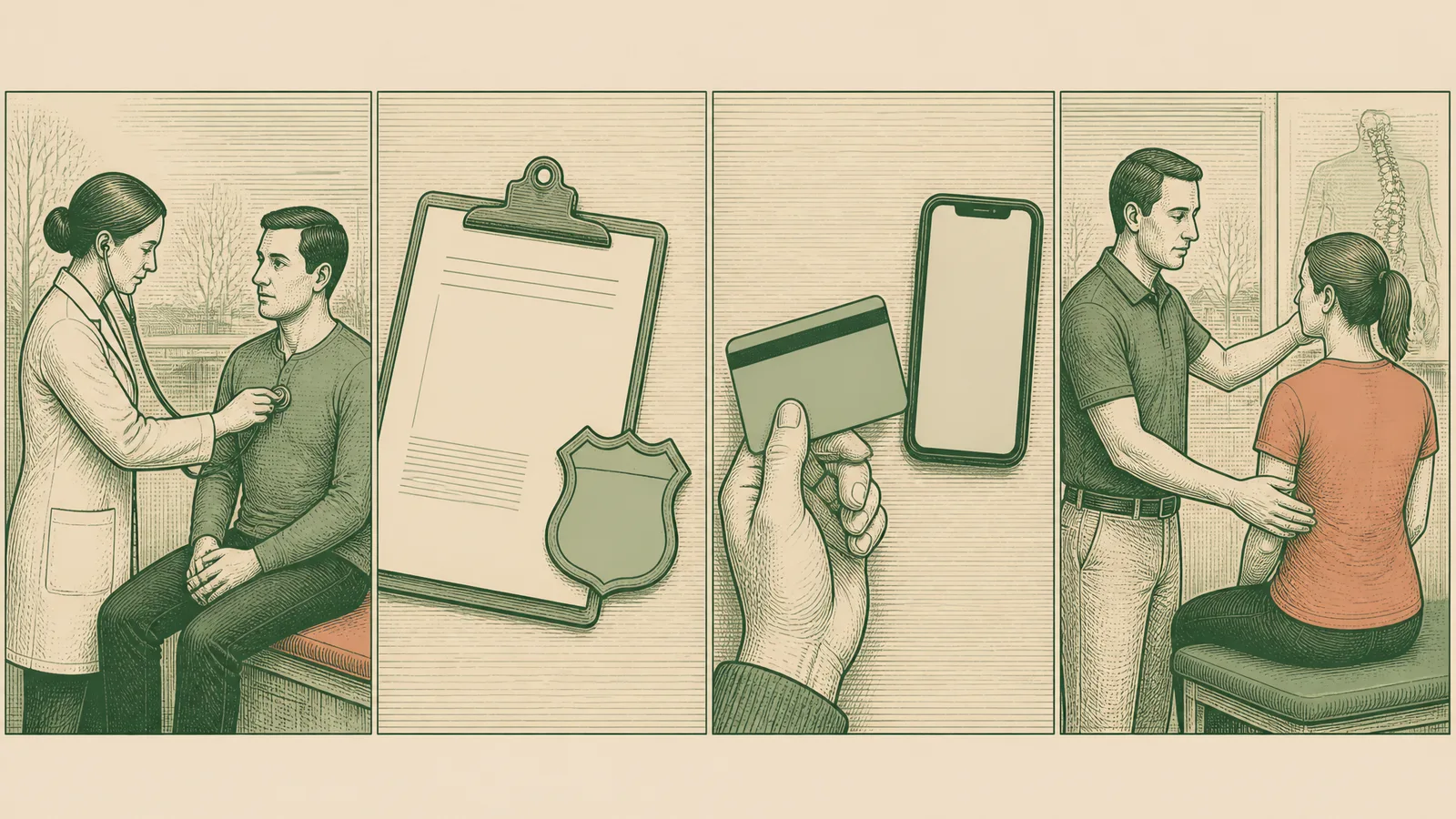
Put the Questions in the Right Order
After a Cincinnati-area crash, start with the question that can become urgent fastest: What is happening medically right now?
If there are serious or rapidly worsening symptoms, use appropriate emergency or medical care. Do not delay a medical decision because you are trying to locate a crash report or understand an insurance policy.
Once the immediate safety question is handled, the remaining questions become easier to separate.
Medical Care Answers Medical Questions
A hospital, emergency department, urgent-care clinician, primary-care clinician, or other appropriate medical provider evaluates medical concerns based on the situation.
That is different from a musculoskeletal chiropractic evaluation.
If you were already evaluated and later notice new or worsening warning signs, respond to what is happening now and follow your discharge instructions. The earlier visit does not make future symptoms irrelevant.
For the full warning-sign list, use warning signs after a car accident.
The Official Crash Report Follows the Agency That Investigated
Cincinnati-area crashes can involve different jurisdictions.
The useful question is not “Where do I live?” It is “Which law-enforcement agency investigated this crash?”
The Ohio crash-search system can help locate a report, but the investigating agency is the official record holder.
Ohio’s crash-report search system.
If Cincinnati Police investigated the collision, the city’s police records process applies. If Green Township Police investigated it, use the township process. White Oak can involve more than one jurisdiction depending on where the collision occurred.
The site already breaks those distinctions out on the Green Township accident page, White Oak accident page, and Westwood accident page.
That local distinction is more useful than a generic instruction to “get the police report.”
Insurance Coverage Comes From the Policy, Not the Clinic
An Ohio liability-limit number does not tell you what your personal medical benefits are.
Likewise, the fact that another driver has insurance does not allow a chiropractic office to tell you what an insurer will pay, who is at fault, or what a claim is worth.
Those are separate questions.
Your insurer or policy documents answer coverage questions. The clinic can answer its own pricing and payment policies.
Spine & Motion is a cash-pay office. For the fuller explanation, read car insurance and chiropractic care after an Ohio accident.
Clinic Cost Is a Clinic Question
Patients often mix “What does the office charge?” with “Will insurance pay me back?”
They are different.
The office controls its own pricing and payment process. An insurer controls what the policy covers and how it handles reimbursement or claims.
Keeping those questions separate makes the conversation much clearer.
If you want current office details, contact Spine & Motion.
Musculoskeletal Follow-Up Has Its Own Purpose
After urgent medical questions have been handled, some people are left with neck pain, back pain, shoulder-area soreness, stiffness, headaches associated with neck symptoms, or difficulty with normal movement.
A chiropractic evaluation may be appropriate when the remaining question is musculoskeletal.
That evaluation should focus on what changed, what the examination finds, what function is limited, and whether the problem belongs in this office.
It should not be used to determine legal fault or assign a value to an insurance claim.
The main car accident chiropractic care guide explains the clinical role in more detail.
Bring Useful Information, Not a Self-Diagnosis
If you decide to schedule a musculoskeletal evaluation, useful information can include:
- when and how the collision happened
- whether you were the driver or passenger
- where you were seated
- whether you were evaluated elsewhere
- what instructions you were given
- what symptoms changed afterward
- what normal activities are harder now
- any medications or health conditions the clinician needs to know about
You do not need to decide for yourself which tissue is injured before the appointment.
The new patient guide explains what to expect at Spine & Motion.
A Crash Report and a Medical Record Serve Different Purposes
People sometimes talk about “documentation” as if every record after a crash is doing the same job.
It is not.
The police or crash report documents the collision from the investigating agency’s perspective. It may include information about location, vehicles, drivers, roadway conditions, and other facts collected during the investigation.
A medical record documents what a healthcare professional evaluated, what the patient reported, what findings were recorded, and what care or instructions were provided.
One record does not replace the other.
A police report does not diagnose an injury. A medical record does not determine legal fault.
Keeping those purposes separate makes the paperwork easier to understand.
Keep the Records You Are Actually Given
If you were evaluated in an emergency department, urgent care, primary-care office, or another setting, keep the discharge instructions and records provided to you.
If a law-enforcement agency gives you a report number or instructions for obtaining the official crash report, keep that information too.
If you speak with your insurer, keep the policy information and claim-contact details that the insurer provides.
You do not need to turn your kitchen table into a claims office.
The point is simply to avoid losing the basic information that belongs to each part of the process.
Insurance Questions Should Be Specific
“Will insurance cover this?” can hide several different questions.
Which policy are you asking about?
Are you asking whether the office bills insurance directly?
Are you asking whether your policy has a benefit that may reimburse you?
Are you asking what another carrier says it will pay?
Those are not interchangeable.
Spine & Motion can explain its own cash-pay pricing and payment process.
The insurer or policy documents are the source for coverage and reimbursement decisions.
That separation matters because a clinic should not promise an insurance result it does not control.
Ohio Liability Limits Do Not Tell You Your Medical Benefit
Ohio’s minimum auto-liability requirements are legal coverage limits.
They do not tell you what your personal health insurance covers, what medical-payments coverage you may or may not have, whether another insurer accepts a particular expense, or what a clinic will charge.
A statutory number is not a medical-benefit explanation.
If you need to understand a policy, use the insurer or the policy documents.
If you need to understand the clinic’s fee, ask the clinic.
Do Not Let Insurance Timing Replace Medical Judgment
After a crash, people may feel pressure to make medical decisions based on what they think an insurance company expects.
That is the wrong order.
Urgent medical concerns should be handled because of the symptoms, not because of a claims timeline.
Musculoskeletal follow-up should be considered because of the remaining clinical problem and functional limits, not because someone believes a claim requires a certain number of visits.
The medical decision should remain medical.
The Investigating Agency Can Be a Local Detail
Cincinnati-area crashes do not all flow through one records office.
A collision within Cincinnati may involve Cincinnati Police. A crash in Green Township may involve Green Township Police. White Oak can involve more than one jurisdiction depending on the exact location and responding agency. Other crashes may involve Colerain Township, the Ohio State Highway Patrol, or another agency.
That is why the site’s locality pages focus on identifying who investigated the crash.
It is more useful than telling every reader to call the same office.
What to Bring to a Musculoskeletal Follow-Up
If urgent medical issues have been addressed and you are considering chiropractic evaluation for neck, back, shoulder-area, or movement complaints, useful information may include:
- when and where the crash occurred
- whether you were the driver or passenger
- where you were seated
- whether seat belts or airbags were involved
- medical evaluations already completed
- discharge or follow-up instructions
- current medications and relevant health history
- what symptoms changed after the collision
- which normal activities are harder now
You generally do not need the official police report in hand for a clinician to hear your history and evaluate a musculoskeletal complaint.
The clinical visit and the records process are separate.
A Functional Record Can Be Simpler Than a Symptom Diary
Some people try to document every sensation throughout the day.
That can become exhausting.
A simpler approach is to track several meaningful activities.
Can you turn your head farther this week than last week? Sit longer at work? Sleep with fewer interruptions? Walk normally? Lift an ordinary household item?
Those observations can help show whether function is changing without turning recovery into a minute-by-minute project.
The Practical Framework
When several post-crash questions are competing for attention, sort them by owner:
Medical safety: the appropriate medical provider.
Official crash report: the investigating agency.
Insurance coverage: the insurer and policy.
Clinic cost: the clinic.
Musculoskeletal follow-up: the clinician evaluating the neck, back, shoulder, or movement complaint.
That is the central idea behind the Cincinnati post-crash decision guide.
It is not about creating more steps.
It is about making the next step easier to identify.
Start With the Question That Has the Clearest Owner
When several tasks feel urgent, pick the question with the clearest source. New or worsening symptoms belong with appropriate medical care. A report question belongs with the investigating agency. Coverage belongs with the insurer. Clinic pricing belongs with the clinic. That simple sorting step can prevent delaying another decision that matters more.
Why This Separation Matters
A crash creates stress because several systems start moving at once.
Medical care may be addressing symptoms. Police may be completing the official record. Insurance companies may be asking questions. Work or family responsibilities may continue even when normal movement is harder.
The easiest way to reduce confusion is to stop asking one source to answer every question.
Medical providers answer medical questions. The investigating agency controls the official report. The insurer controls policy decisions. The clinic controls its pricing. A musculoskeletal clinician evaluates whether the neck, back, or movement complaint fits the care they provide.
That is the framework behind Spine & Motion’s accident-care content.
For the practical sequence, start with what to do after a car accident in Cincinnati. If symptoms became more noticeable later, use delayed pain after a car accident.
Published August 21, 2026
Care at Spine & Motion is provided by Nicholas Heuker, DC.