Older adults
Older Adults After a Car Accident: Why the Same Crash Can Need a Different Response
Age does not tell you what injury someone has, but it can change the level of concern after a collision. Head injury, medications that affect bleeding, bone health, balance, and other medical conditions can all influence what kind of evaluation should come first.
If symptoms are severe, rapidly worsening, or you have an emergency warning sign after a crash, call 911 or go to an emergency department. Some symptoms after a head or body jolt can appear hours or days later. Review the warning signs after a car accident if you are unsure what deserves emergency care.
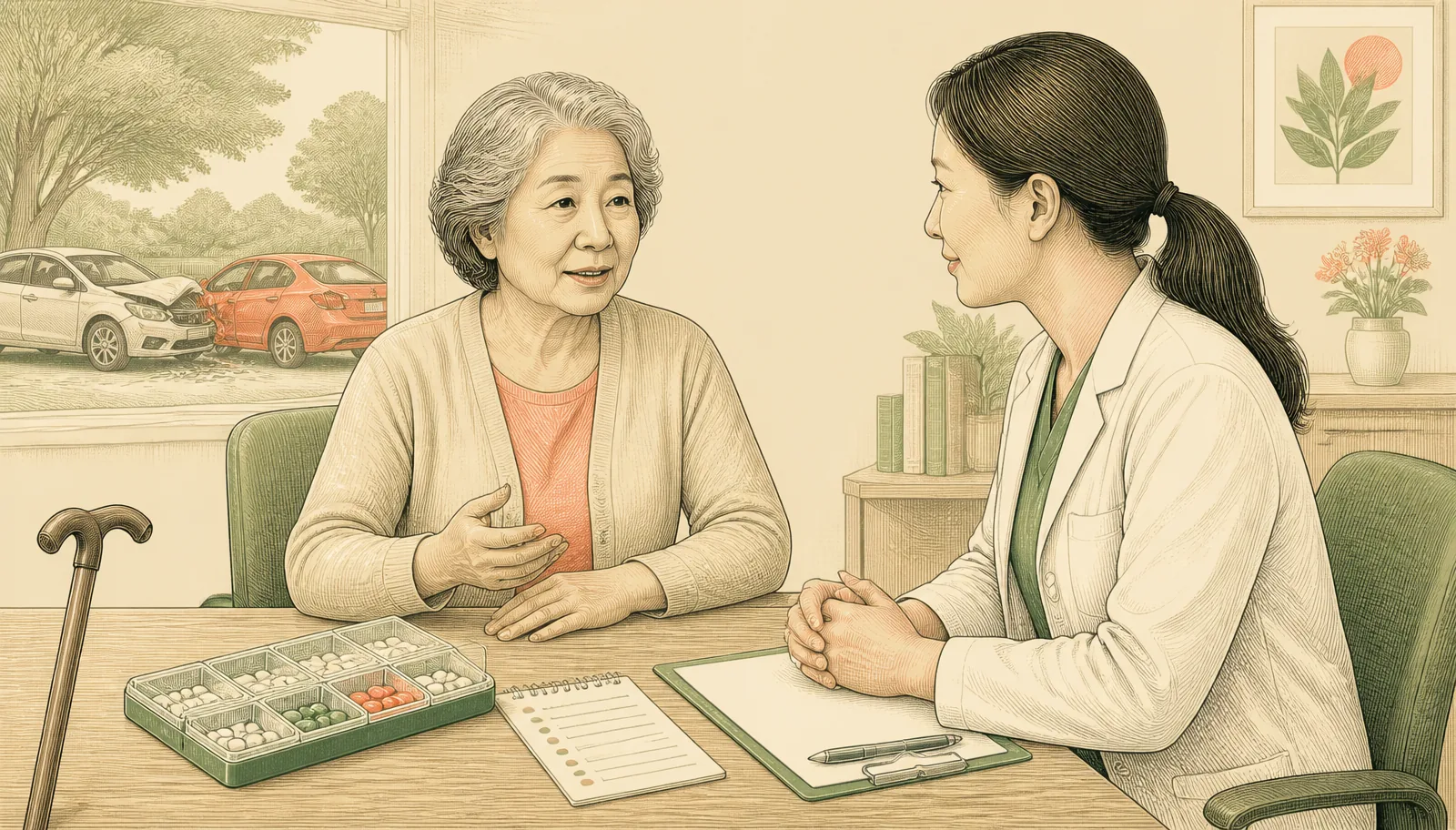
Head Injury Deserves Extra Attention
The CDC identifies older adults as an important group in traumatic brain injury prevention and care. A head or body jolt can produce concussion symptoms even when the person did not lose consciousness, and some symptoms can appear later.
CDC information on traumatic brain injury in older adults.
If there is a worsening headache, repeated vomiting, confusion, unusual behavior, weakness, seizure, marked drowsiness, trouble waking, or another concussion danger sign, use emergency care rather than a routine musculoskeletal appointment.
Review the post-crash warning signs.
Blood Thinners and Bleeding Risk Matter
If the person takes an anticoagulant, antiplatelet medicine, or another medication that affects bleeding, tell the medical clinician evaluating the crash. Do not stop a prescribed medicine because of a blog article.
A medication list is useful after a collision because it gives the clinician context without relying on memory for exact names or doses.
Bone Health Can Change the Medical Question
Osteoporosis and other conditions that weaken bone can make significant trauma more concerning. A website cannot determine whether a fracture occurred from pain level, bruising, or the fact that someone was able to walk away from the crash.
When fracture is a concern, medical evaluation and any imaging decision belong with an appropriate medical clinician before hands-on spinal care.
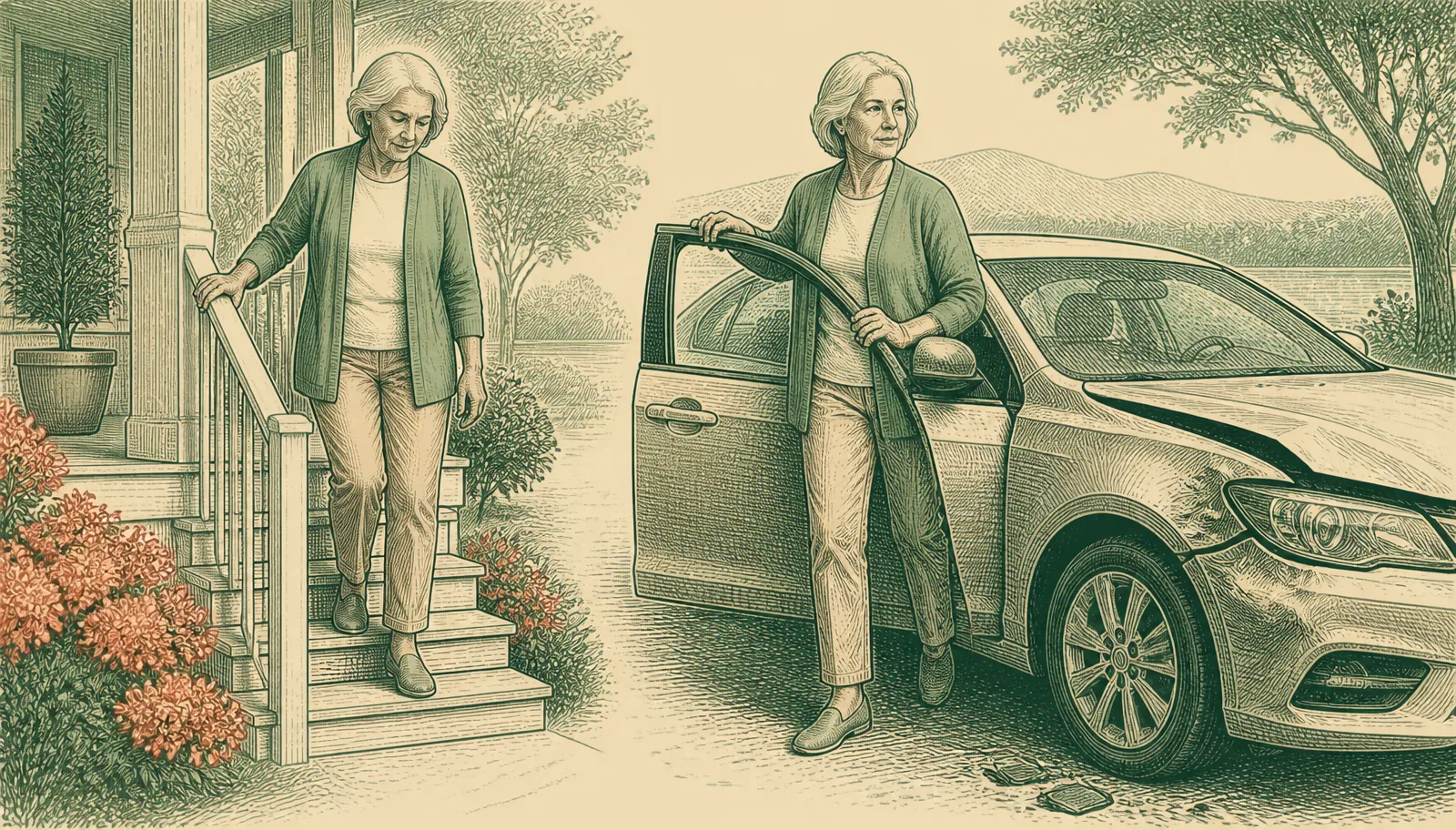
Recovery Should Be Judged by Function, Not Age Alone
An older adult should not be told that slow recovery is simply “because of age,” and a younger person should not be promised a fast recovery for the same reason. The injury, baseline health, medications, sleep, activity, balance, and the demands of daily life all matter.
Useful changes to notice include whether walking, getting dressed, getting in and out of a car, sleeping, turning the head, or managing normal household tasks are becoming easier or harder.
When a Musculoskeletal Evaluation May Fit
After urgent medical concerns have been addressed, persistent neck or back soreness, stiffness, or limited movement may be reasonable to evaluate conservatively. The role of the examination is to determine whether the complaint appears musculoskeletal and whether another kind of care should come first.
See car accident injury evaluation and chiropractic care.
Age Changes the Questions, Not the Need for Individual Evaluation
An older adult should not be treated as fragile simply because of age. At the same time, age can change the background risk after a collision.
Bone density may be lower. Balance may already be less forgiving. Some people take medications that affect bleeding or alertness. Others have arthritis, prior joint replacements, previous spinal problems, or medical conditions that change how symptoms should be interpreted.
That means the same complaint can require a different level of caution depending on the person.
The right approach is not to assume the worst. It is to avoid assuming that a routine soreness pattern is the whole story before the history is understood.
Medications Belong in the Accident History
A medication list can matter after a crash for reasons that have nothing to do with chiropractic treatment.
Blood-thinning or antiplatelet medicines can affect how a clinician thinks about bruising, bleeding risk, or head-injury concerns. Sedating medicines can affect alertness, balance, and driving. Other prescriptions may matter because they influence blood pressure, bone health, or the way symptoms are experienced.
This is one reason a complete medication list is useful at a follow-up visit.
Do not stop or change a prescribed medicine because of a website article. Medication decisions belong with the clinician who manages that medicine or another appropriate medical professional.
Head Symptoms Deserve Particular Attention
Older adults have a higher risk of serious injury from falls and head trauma, and a motor-vehicle collision can also involve a head or body jolt.
A headache, dizziness, confusion, unusual sleepiness, repeated vomiting, weakness, numbness, trouble walking, or another neurological change should not be reduced to a routine neck complaint.
CDC guidance for older adults emphasizes the importance of recognizing changes after injury and taking fall and brain-injury risks seriously.
That does not mean every older person with a headache has a concussion. It means the threshold for paying attention to concerning changes should be thoughtful.
Bone Health Can Change the Evaluation
Not every older adult has osteoporosis, and not every collision causes a fracture.
But known osteoporosis, osteopenia, long-term steroid use, prior compression fractures, or other bone-health concerns are relevant parts of the history.
Why?
Because a treatment that might be reasonable for one person may not be reasonable for another person with different bone strength or trauma history.
The decision about imaging, manipulation, referral, or another type of care should come from the individual clinical picture.
Balance and Mobility Are Functional Measures Too
Pain is only one part of recovery.
For an older adult, small changes in balance or mobility can have a big effect on independence.
Can the person get out of a chair without using the arms more than usual? Is walking slower? Is getting into the car more difficult? Is turning to look behind while walking or driving uncomfortable? Is the person avoiding stairs that were routine before the collision?
Those are useful functional questions.
At Spine & Motion, the Function Snapshot idea can be especially helpful here because it compares the person with their own pre-crash baseline rather than with someone younger or more athletic.
“I Already Had Arthritis” Does Not Make New Change Meaningless
Many adults have imaging findings or prior diagnoses before a crash.
The useful question is not whether the spine was perfectly normal before the collision. The useful question is what changed.
If someone had mild stiffness for years but could sleep normally, drive comfortably, and walk without restriction before the crash, then new functional limitations still deserve to be described accurately.
A pre-existing condition can be part of the history without explaining every new symptom automatically.
The reverse is also true. A collision does not prove that every existing condition became worse.
The evaluation has to separate baseline from change.
Family Observations Can Be Useful
Sometimes the injured person notices pain but a family member notices function.
They may see that the person is more hesitant on stairs, moves more slowly getting out of a chair, repeats questions, avoids driving, or seems less steady.
Those observations can be useful, especially when they describe a clear change from normal.
They should not replace the patient’s own report or a medical evaluation. They can add context.
Returning to Driving May Need More Than a Pain Check
Driving requires head movement, attention, reaction time, vision, coordination, and the ability to manage medication effects.
An older adult who feels “mostly okay” may still notice that checking a blind spot is difficult or that turning the head causes enough discomfort to distract from the road.
That does not mean a chiropractor can medically clear someone to drive.
It means driving is one of the real-world functions worth discussing.
If there is dizziness, confusion, sedation, major movement restriction, or another concern that could affect safe driving, the appropriate medical guidance matters.
A Musculoskeletal Visit Should Still Have Limits
If urgent medical concerns have been handled, chiropractic care may be relevant for some older adults with neck, back, or movement complaints.
The evaluation should ask whether the problem is appropriate for the office, whether the person has risk factors that change the plan, and whether another type of evaluation should come first.
There should not be a universal “senior treatment plan.”
There should be a reason for care, a way to measure meaningful progress, and reassessment when the plan is not producing useful change.
What to Bring
For an older adult after a car accident, useful information can include:
- a current medication list
- known osteoporosis or bone-health history
- previous fractures or surgeries
- use of a cane, walker, or other mobility aid before the crash
- the medical evaluation already completed
- discharge or follow-up instructions
- what normal activities changed after the collision
- observations from a family member when they describe a real change
That information helps the clinician understand the person who was in the crash, not just the crash itself.
The Cincinnati post-crash decision guide can also help separate medical questions, official records, insurance questions, and musculoskeletal follow-up so each concern goes to the right source.
Small Functional Changes Deserve Specific Language
“More unsteady” or “moving slower” can be hard to evaluate unless the change is connected to a real activity. Was the person using the handrail before the crash, or only afterward? Could they step out of the car without pausing before? Are they now avoiding the basement stairs, carrying laundry differently, or asking for help with a task they normally handled alone? Specific examples make the change easier to understand and easier to reassess later.
Published September 10, 2026
Care at Spine & Motion is provided by Nicholas Heuker, DC.