Occupants
Passengers and Drivers Can Experience the Same Car Accident Differently
Two people in the same vehicle do not automatically have the same injury. Seat position, head position, restraint use, what each person was doing at the moment of impact, and individual health can all change the history a clinician needs to hear. None of those details proves a diagnosis on its own.
If symptoms are severe, rapidly worsening, or you have an emergency warning sign after a crash, call 911 or go to an emergency department. Some symptoms after a head or body jolt can appear hours or days later. Review the warning signs after a car accident if you are unsure what deserves emergency care.
Start With What Each Person Actually Experienced
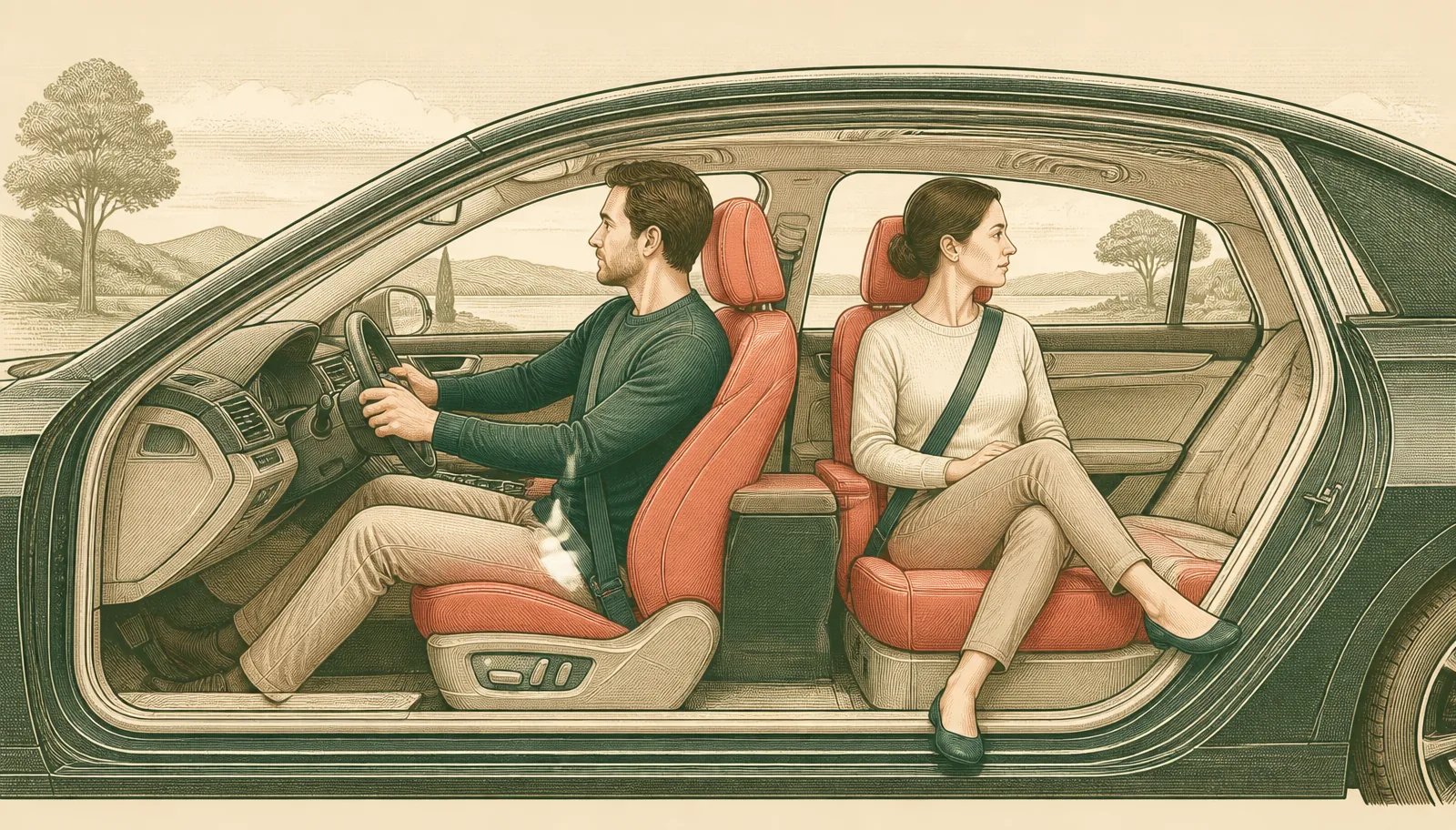
A driver may have been looking toward traffic, holding the steering wheel, braking, or turning the head. A passenger may have been looking down, turned toward another person, reaching for something, or simply not anticipating the impact.
Those details are worth reporting because they describe position and function at the time of the collision. They should not be converted into a certainty that one occupant “must” have a particular injury.
Seat Position Is Part of the History, Not the Diagnosis
Front seat, rear seat, driver, and passenger positions can involve different restraint systems and body positions. The useful clinical question is what happened to the individual person and what symptoms or limitations followed.
NHTSA’s seat-belt guidance emphasizes that proper restraint and seating position matter for both drivers and passengers.
Do not use a seat-position chart to decide who was hurt more. Injury severity depends on far more than where someone was sitting.
Restraints Matter Too
Seat belts and airbags are designed to reduce the risk of severe injury and death, but an occupant can still have soreness or injury after the restraint system does its job. Whether an airbag deployed or a seat belt left tenderness is information to report, not a diagnosis.
Read more about seat belts, airbags, and post-crash soreness.
What Should Each Occupant Track?
- Where they were sitting
- Whether they were wearing a seat belt
- Whether an airbag deployed near them
- Which direction they were facing or looking
- What they noticed immediately and what appeared later
- Which ordinary movements or activities are different now
Each person should describe their own experience rather than borrowing another occupant's symptoms or assuming the same care plan fits everyone in the vehicle.
When Medical Care Comes First
A head injury concern, severe or worsening symptoms, neurological changes, chest or abdominal symptoms, or another emergency warning sign belongs with medical care first, regardless of whether the person was the driver or a passenger.
Review the post-crash warning signs.
When a Musculoskeletal Evaluation May Fit
After urgent concerns have been addressed, ongoing neck or back soreness, stiffness, or reduced movement can be reasonable to evaluate. The examination should be based on that person's history and findings, not on what happened to someone else in the car.
See car accident injury evaluation and chiropractic care.
Same Crash Does Not Mean Same Body Position
Two people can be sitting a few feet apart and still experience the collision differently.
The driver may have both hands on the wheel and one foot on a pedal. A passenger may be relaxed, turned toward the driver, looking down, reaching into a bag, or sitting at a different distance from the dashboard.
Those differences can change how the body moves when the vehicle is struck.
That does not let anyone predict injury severity from seating position alone. It explains why “we were in the same crash” does not mean “we should feel exactly the same afterward.”
Restraints Work Differently Around Different Positions
Seat belts are designed to restrain the body in a normal seated position. If someone is rotated, leaning, or reaching when the crash happens, the belt may contact the body differently.
NHTSA’s seat-belt guidance emphasizes that proper restraint and seating position matter for both drivers and passengers.
That information is useful for understanding occupant protection. It still cannot tell you which tissue is injured after one specific crash.
Compare Function, Not Stories
It is easy for passengers and drivers to compare symptoms.
“Why is my neck worse than yours?”
“Why are you sore already and I am not?”
Those comparisons are understandable, but they are not very useful clinically.
A better comparison is with your own normal function before the collision.
Can you turn your head normally? Sit comfortably? Reach overhead? Sleep the way you usually do? Walk, lift, or work without guarding?
That gives the evaluation a clearer starting point.
The Person Matters More Than the Seat Label
Driver versus passenger is part of the history, not a diagnosis.
Age, prior conditions, medications, body position, restraint use, the direction of force, and what happened immediately afterward can all matter.
That is why Spine & Motion’s broader Cincinnati car accident recovery guide separates the event from the clinical decision. The crash explains context. Current symptoms, warning signs, examination findings, and functional change help determine what should happen next.
If urgent medical concerns have been addressed and the remaining complaint is musculoskeletal, an evaluation can help sort out whether the problem fits chiropractic care or whether another type of follow-up makes more sense.
Different Symptom Timing Does Not Settle the Comparison
One occupant may notice soreness immediately while another notices more stiffness later. That difference is part of each person’s history, not proof that one person was injured and the other was not. Compare each person with their own baseline, warning signs, movement, and daily function. The timing can help describe the story, but it should not become the diagnosis.
Each occupant should tell their own story. Who was seated where, how they were positioned, what restraints were used, what medical evaluation occurred, and what function changed afterward can differ even inside one vehicle. That individual history is more useful than assuming the driver and passenger should recover on the same schedule.
Published September 2, 2026
Care at Spine & Motion is provided by Nicholas Heuker, DC.